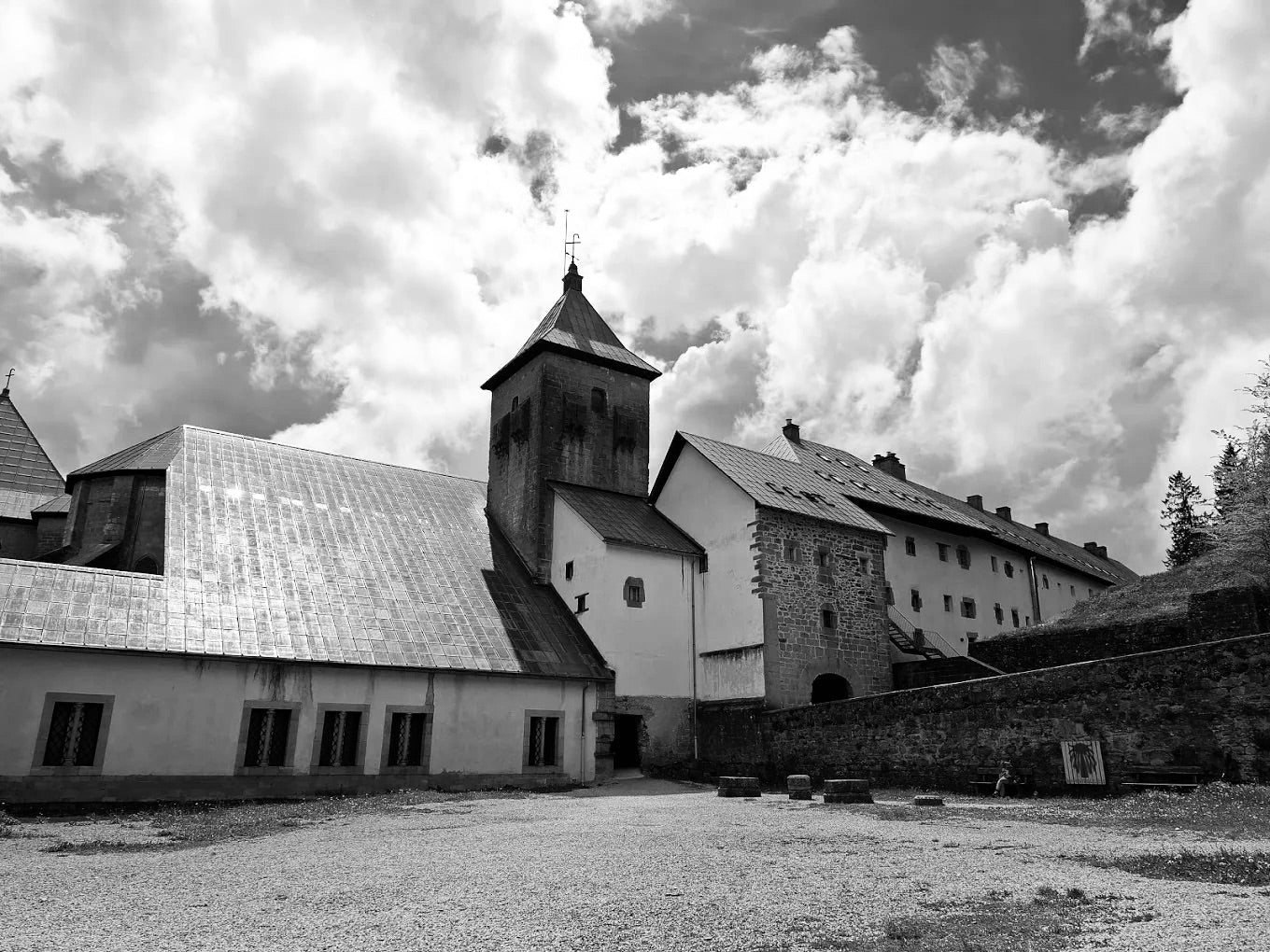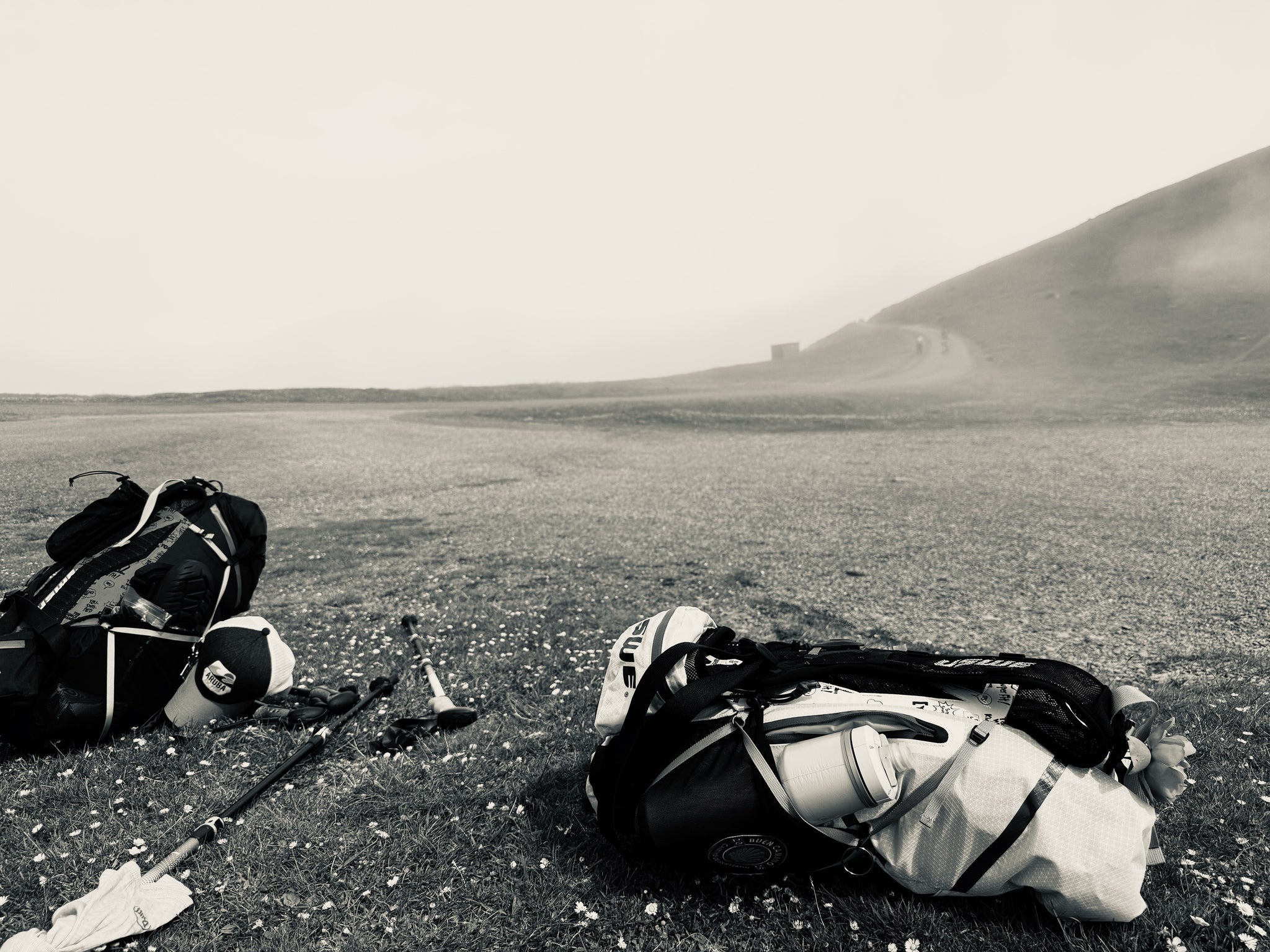
Wide-eyed and heavy-footed, we entered through an arched doorway into a massive building dating back to the 12th century. It was the culmination of our first day on the Camino and the grandeur of the building felt like a worthy ballast after a day spent among the clouds.
The lengthy hallway entrance was paved with stone, connecting with various rooms and stairwells on one side, tables and benches on the other. At the far end we could see a line, presumably for checking in. It snaked into a separate administrative space behind a wall of windows. Looking around, I observed an industrial-style kitchen, a room for muddy hiking shoes and poles, and multiple entrances to various stairwells. We moved directly toward the line where we established our place, and then—with the most tremendous sense of relief imaginable—we lowered our packs onto one of the benches along the wall. We had officially made it.
We were among a dozen or so newly arrived pilgrims. There were others who had shown up ahead of us—having already climbed stairs to one of the three levels of bunks or even post-shower with blistered feet airing out on the squishy plastic covers of bunk mattresses. Miles behind us, there must have also been other weary pilgrims still trekking, wondering how they would find their way in the dark.
Although there were some seasoned pilgrims among us—those who had made walking the Camino a lifestyle—most of us had only just begun. Still, there was a distinct feeling in the air among those who had arrived in Roncesvalles. We had already changed. In just twelve hours we had acquired more than a glimpse of what it meant to be on the Camino. We all knew something we hadn’t previously known. We had expanded our awareness of what we were made of, the question of what would sustain us coming into focus. We knew we could find our way around, and we knew we were in it together. Even on that very first day, it was abundantly clear: we were not alone.
A crew of Scandinavian volunteers huddled around the check-in area. I sensed some annoyance I couldn’t quite put my finger on. Connecting with one of the older gentlemen—most of the helpers obviously retirees—I quickly made a friend, our blue eyes meeting. At the register, where we paid for our beds, we were given two bright-pink laminated coupons for our pre-ordered spot at dinner.
In the shoe room, squished together on a small bench, Jonah and I unlaced our sneakers, deeply appreciative we’d chosen a style of hiking shoe that had left our feet intact. We could have been in much worse shape. Then, peeling off damp socks, we located our second pair of shoes, pulling them from our packs. Jonah had chosen black Teva-style sandals for the evenings, and I had picked a navy-blue pair of slip-ons with a single toe loop and a colorful braid of fabric on one side. Finally, before leaving the room, we tied our poles together—something that would become our practice—placing them into a barrel-like container where we would find them in the morning without any confusion. I couldn’t help but identify with the image of our poles, feeling tied together with my son in the most comforting way.
In the stairwell, the two-story climb to our bunks was amusing. In the time it took to check in, our bodies had cooled and stiffened, and while the climb paled in comparison to the heights we’d covered that day, we found every step to be strenuous.
Upstairs we discovered a layout of four-bed groupings—two sets of bunks and four lockers all together within arm’s reach. The length of the building was filled with these accommodations and on the far side were a single male and female bathroom. Inside were three or four shower stalls and the same number of sinks. Finding our bunk number, we discovered the opposite beds within our grouping had already been occupied, clothing and other belongings left on top of them. Windows lined the length of the building across from the bunks. They were cracked open into a grey courtyard where the drizzle of rain landed on a pebble strewn square.
Jonah and I quickly began unpacking. Isolating our sweaty clothing, finding our toiletries to take to the showers. Jonah had opted to carry a light sleeping bag—a welcome comfort after such a challenging day on a damp night. To protect my neck and back from extra weight, I had opted not to carry one, only relying on a thin sheet and whatever layers of clothing I had for warmth. Many of my initial nights on the Camino were spent struggling to stay warm. Later it would be a relief to travel so light on scorching days. I kept suggesting Jonah let go of his sleeping bag, but he carried it the entire way. On the Camino, we were always considering what we were holding, and what it was time to set down.
Having gone to the showers ahead of me, Jonah returned from the men’s bathroom visibly chilled with purple lips. There had been no hot water in his shower. Expecting the same, I tiptoed into the compact bathroom stall, carefully hanging my evening clothes just beyond the shower head, then pressing a metal button and bracing myself. Much to my surprise, warm water came pouring out. Working for only ten or twenty-second intervals, I pressed the button repeatedly, attempting to wash off the weight of the day and absorb the heat into my tight muscles.
Other pilgrims with wet hair moved quickly within the bathroom, obviously attentive to the nature of shared spaces. We found privacy within our union, limiting conversations, and tucking into our interior spaces, coming and going from rooms where we cleansed our bodies and spirits.
Soon we were joined by one of our bunk mates, a quintessential Englishman with white hair and an upbeat attitude. He let us know he didn’t hear all that well and mentioned his propensity for snoring—both of which proved abundantly accurate. When he introduced himself as Ian, his name landed as a sign—the same as Jonah’s best friend back at home. His wife joined us later, exuding an equally lovely demeanor. There was some question we had at the time that they attempted answering for us with their guidebook. They were the first to parent us on the Camino.
It turned out we’d unknowingly purchased the mid-tier dinner, a more upscale offering being served in a separate and beautifully adorned space. Ever the foodie, Jonah was disappointed to be left out of the opulent offering. I told him there would be other opportunities for exquisite meals—besides, this isn’t why we’re here. I appreciated that he didn’t press the issue.
In the more modest dining room, we were seated at a round table that was already nearly full. An American couple beside us were newly engaged, one of the pair about to enter medical school. A joint adventure to mark the beginning of a shared life. I wondered about the way these stories—these many interesting individuals we were already meeting—would impact Jonah’s view of the world, the ideas it would formulate in his life which, in a sense, was just beginning.
At this first communal dinner, we and our dining companions were subdued—unlike the dinner meal the following evening. Here we were all exhausted, perhaps a bit apprehensive, and reserved. The menu was simple—fish, chicken or beef—options we’d encounter again and again. An older Asian couple who sat across the table seemed very content. With no shared language between us, we allowed our happy eyes to communicate for us. The gentleman had an especially wide smile and enjoyed the wine. We would meet him and his wife again.
I slept very little that night—the thunder, the snoring, the cold. My mind was active with thoughts of how we’d fare the following day. The forecast showed more rain. I must have finally drifted off to sleep, because when I awakened to the sound of bells, Ian and his wife had already gone, their beds empty and tidy. I climbed out from my bottom bunk and crept over to the window. Peering out, I was mesmerized by the haunting sound of Gregorian chanting, and the steady downpour of rain. ✨
Subscribe to my mailing list!
Leave a comment (all fields required)
Comments will be approved before showing up.